In typical Amtrak style, I’m writing this while aboard a train running late. Two hours and thirty minutes late—to be exact (correction: now two hours and forty five minutes late). If I expected them to be on time I’d be frustrated and would likely swear this to be my last time aboard an Amtrak train. But that’s not the case. I understand up front that Amtrak will almost absolutely be late. It comes with the territory and is the product of a flawed system. More on that later.
Why ride the train? Well, my place of employment is two hours (by car) from my place of residence. I could sit behind the wheel four hours weekly if I wanted to avoid the shortcomings of the train. Most people, actually, would prefer to strapping in behind the wheel and giving it a go on the highways. I prefer to use the time for myself and not spend the commute time stuck in a car. I can instead spend the (quoted) three hours on the train working, reading, sleeping, or any other such chore. It’s my time. I’ve taken it back and made it my own.
I’ve especially utilized Amtrak’s services now in the winter months. I’d prefer not to contend with the cold commute that is often slowed and hindered by Michigan’s winter snow and ice.
Many ask how much it costs for a roundtrip ticket. Almost as much of a tank of gas (and I suspect it will soon be cheaper considering the upward gas prices). Not bad at all! My gas consumption as a driver has dropped dramatically now that I’ve switched to regular train travel. My environmental footprint is being reduced each time I decide to purchase a ticket and board a vessel that’s already traveling my way. My train ticket represents one less car on the road.
Patronage of Amtrak also supports a service that (for some) is essential. Not everyone owns a vehicle or has access to one. Some people depend on this service to get home for the holidays, make a visit from school, or see family on the other side of the state.
Some may think train travel is a dying method, but that is not the case. On a recent Monday morning, 60 people boarded at one stop! On many occasions most seats are occupied.
I suspect that Amtrak isn’t bringing in loads of cash. The money brought in from fares likely doesn’t offset the costs associated with its operation and upkeep. It’s probably like other forms of local public transportation. Not a money maker but certainly necessary to its clientele.
Why is Amtrak almost always delayed? From what I gather, two major reasons are at play. First, some of the route is single track territory. That means that only one train (either freight or passenger) can pass at a time. On many a trip does the passenger train pull off in a holding area to let another train in the opposite direction pass. It’s a time consuming process. Second, much of the route is shared with freight traffic. It seems that freight traffic trumps passenger traffic. Amtrak seems to have little push in the fight with freight. Oh, and derailments occur occasionally. Be it a passenger or freight derailment, it really slows things up.
What does the future hold for Amtrak and passenger train travel in Michigan?
Positive scenarios for the future:
- What would happen if Michigan residents made rail travel a priority?
- What if there was a designated express rail for commuter traffic?
- What if you could travel from Detroit to Chicago in two hours time via rail?
Negative scenarios for the future:
- What if existing Amtrak service disappeared in Michigan?
- How would a loss or reduction of Amtrak services impact Michigan families already struggling?
- Could bus service handle the new demand from a loss of rail service? Wouldn’t the bus system collapse over the cost of fuel and the influx of new clients?
You’re right; Amtrak isn’t especially reliable because it’s always late. Know this up front and plan accordingly. Rail travel won’t be the best option for every need, but at least explore this option next time you’re planning a trip. Examine the potential benefits and weigh them against the expected costs. You might be surprised.
Showing posts with label environment. Show all posts
Showing posts with label environment. Show all posts
Thursday, January 17, 2008

Tuesday, June 26, 2007
A slight negative for a big positive
While reading this month's Mother Earth News, I came across an interesting bit of information that was completely new to me and I'd like to share it.
"Compact fluorescents do have a downside: They contain tiny amounts of mercury, so instead of throwing them out, they should be recycled or taken to your city’s hazardous waste collection point." (Source)
 Really? Very good to know considering I've made an effort to get more of the compact fluorescents into our residence.
But worry not, even though they contain a tiny bit of mercury, they're still better when you look at the bigger picture and their overall benefits. See below from NPR's Morning Edition.
"...even though fluorescent bulbs contain mercury, using them contributes less mercury to the environment than using regular incandescent bulbs. That's because they use less electricity — and coal-fired power plants are the biggest source of mercury emissions in the air." (Source)
Interested in properly disposing of your compact fluorescents? Check Earth 911 for a site near you! If you're close to an IKEA store, they offer bulb disposal/recycling services.
Switching to the compact fluorescents seemed like a bit of an investment when I purchased a 4 pack from Target for $15 or so. Then I found Costco was offering multi-packs of both 75 and 100 watts at bargain prices (8 Energy Star certified bulbs for around $10). But really, the cost is secondary to the energy savings.
Now that I've learned this information I see that a mercury warning is printed on the side of the bulb. Lesson learned? If you're not reading Mother Earth News, read your light bulbs.
"Compact fluorescents do have a downside: They contain tiny amounts of mercury, so instead of throwing them out, they should be recycled or taken to your city’s hazardous waste collection point." (Source)
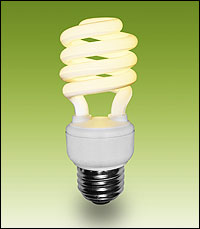 Really? Very good to know considering I've made an effort to get more of the compact fluorescents into our residence.
But worry not, even though they contain a tiny bit of mercury, they're still better when you look at the bigger picture and their overall benefits. See below from NPR's Morning Edition.
"...even though fluorescent bulbs contain mercury, using them contributes less mercury to the environment than using regular incandescent bulbs. That's because they use less electricity — and coal-fired power plants are the biggest source of mercury emissions in the air." (Source)
Interested in properly disposing of your compact fluorescents? Check Earth 911 for a site near you! If you're close to an IKEA store, they offer bulb disposal/recycling services.
Switching to the compact fluorescents seemed like a bit of an investment when I purchased a 4 pack from Target for $15 or so. Then I found Costco was offering multi-packs of both 75 and 100 watts at bargain prices (8 Energy Star certified bulbs for around $10). But really, the cost is secondary to the energy savings.
Now that I've learned this information I see that a mercury warning is printed on the side of the bulb. Lesson learned? If you're not reading Mother Earth News, read your light bulbs.
Subscribe to:
Posts (Atom)